


Let’s be honest—”cool” is the Swiss Army knife of words. We use it for everything: a nice jacket, a good song, an interesting person, even the weather. But when you lean on one word for every situation, your vocabulary starts to feel flat and repetitive. That’s why knowing fresh, natural ways to say cool slang can transform how you express yourself in English.
This article gives you 30 authentic slang alternatives to “cool” that real people actually use in 2024. Whether you’re texting friends, writing dialogue, or just want to sound more natural in conversation, you’ll find the perfect word for every moment. We’ve organized each one with clear meanings, real-world examples, and practical tips so you never misuse them.
Quick Answer
The best slang alternatives to “cool” depend on your audience: “dope” and “fire” work well with younger crowds, “awesome” and “sweet” are universally safe, “legit” signals authenticity, and “lit” describes exciting situations. For professional settings, stick with “impressive” or “excellent.”
Table of Contents
- Why Use Alternatives to “Cool”?
- Casual Everyday Slang Alternatives
- High-Energy Slang for Excitement
- Chill and Relaxed Slang
- Authenticity and Respect Slang
- Comparison Table
- How to Choose the Best Phrase
- Common Mistakes to Avoid
- Writing Tips for Natural Communication
- Related Expressions
- Frequently Asked Questions
- Conclusion
Why Use Alternatives to “Cool”?
Ways to Say Cool Slang help you express excitement, approval, respect, or relaxation more naturally. Relying on one word for every positive reaction limits your communication. Using varied vocabulary makes your conversations sound more fluent, thoughtful, and engaging.
In academic and professional settings, Ways to Say Cool Slang can help you choose more appropriate expressions while still sounding natural. In casual conversations, the right slang helps you connect with different age groups and communities. Whether you’re writing an email, preparing a presentation, or chatting with friends, knowing exactly which word to use makes your message stronger and more memorable.

Casual Everyday Slang Alternatives
These words work in almost any casual situation. They’re widely understood across generations and regions.
1. Awesome
Meaning: Something that inspires genuine admiration or wonder.
Best Used: For genuinely impressive things, big or small.
Tone: Friendly, enthusiastic
Writing Tip: Don’t overuse this one—save it for things that actually deserve emphasis.
Examples:
- “You finished the marathon? That’s awesome!”
- “I just got us front-row tickets for Saturday.”
“No way, that’s awesome.” - “The new restaurant downtown has an awesome rooftop patio.”
- “She gave an awesome presentation—everyone was taking notes.”
2. Sweet
Meaning: Pleasing, satisfying, or exactly what you wanted.
Best Used: When something works out in your favor.
Tone: Casual, upbeat
Writing Tip: Excellent for conveying satisfaction without overstatement.
Examples:
- “They approved your time off? Sweet!”
- “I found your headphones under the couch.”
“Oh, sweet—thanks!” - “That’s a sweet setup you’ve got in your garage.”
- “Free coffee in the break room? Sweet deal.”
3. Nice
Meaning: Pleasantly good or satisfying.
Best Used: For mild-to-moderate approval of everyday things.
Tone: Casual, understated
Writing Tip: Pair it with a specific detail to avoid sounding dismissive.
Examples:
- “Nice catch! I thought that ball was gone.”
- “You got the report early—nice work.”
- “Nice shoes! Where’d you find them?”
- “That’s a nice way to spend a Sunday afternoon.”
4. Rad
Meaning: Excellent or impressive; short for “radical.”
Best Used: In laid-back, slightly retro or skate-culture contexts.
Tone: Informal, nostalgic
Writing Tip: Know your audience—this word has strong 80s/90s energy.
Examples:
- “Did you see him land that trick? So rad.”
- “This vintage record player is actually pretty rad.”
- “They converted an old bus into a tiny home. Rad idea.”
- “Her Halloween costume was rad—totally handmade.”
5. Neat
Meaning: Cleverly interesting or pleasingly tidy.
Best Used: For clever solutions, interesting facts, or well-organized things.
Tone: Mildly enthusiastic, slightly old-fashioned
Writing Tip: Works well in polite conversation; may sound dated to younger speakers.
Examples:
- “That’s a neat way to organize your books by color.”
- “I learned a neat trick for peeling garlic with two bowls.”
- “He showed me this neat little coffee shop hidden behind the bookstore.”
- “Neat handwriting, by the way. Mine looks like chicken scratch.”
| Phrase | Tone | Best Use | Formality |
| Awesome | Enthusiastic | Impressive achievements | Informal |
| Sweet | Upbeat | Satisfying outcomes | Very informal |
| Nice | Understated | Everyday approval | Casual |
| Rad | Nostalgic | Skate/surf culture | Very informal |
| Neat | Mildly enthusiastic | Clever observations | Casual |
High-Energy Slang for Excitement
When “cool” isn’t enough and you need to express real excitement, reach for these words.
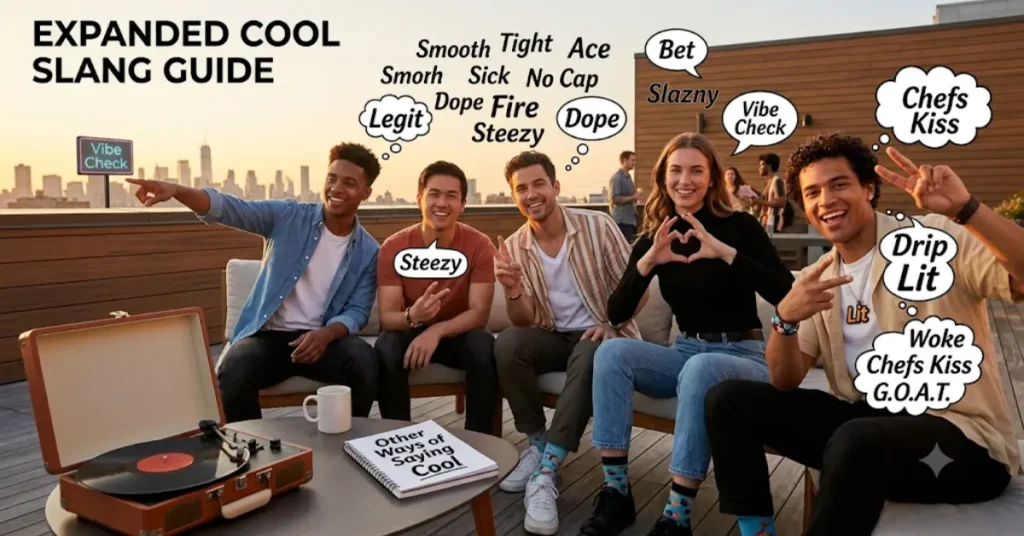
6. Lit
Meaning: Extremely exciting, energetic, or excellent.
Best Used: For parties, events, or experiences with high energy.
Tone: Enthusiastic, youthful
Writing Tip: Reserve for situations with actual buzz—don’t describe a calm dinner as “lit.”
Examples:
- “The concert last night was absolutely lit.”
- “Wait until you see the decorations—this party’s going to be lit.”
- “Her performance during the talent show? Lit.”
- “The crowd was lit from the first song to the encore.”
7. Fire
Meaning: Exceptionally good, impressive, or stylish.
Best Used: For music, fashion, food, or creative work.
Tone: Intense, approving
Writing Tip: Pairs naturally with creative fields—art, music, design.
Examples:
- “That new album is straight fire.”
- “You have to try the tacos at that truck—they’re fire.”
- “His new sneaker design is fire. Completely original.”
- “She dropped a fire verse on that track.”
8. Dope
Meaning: Excellent, impressive, or fashionable.
Best Used: For anything stylish, clever, or high-quality.
Tone: Youthful, urban
Writing Tip: Works across many contexts—objects, people, ideas.
Examples:
- “That jacket is dope. Where did you get it?”
- “The special effects in that movie were so dope.”
- “I just finished reading his book. It’s seriously dope.”
- “Dope idea to combine the two events.”
9. Sick
Meaning: Amazingly good or impressive.
Best Used: For extreme sports, bold designs, or remarkable skills.
Tone: Edgy, enthusiastic
Writing Tip: Context matters—make sure the positive meaning is clear.
Examples:
- “That backflip off the ramp was sick.”
- “Have you seen the concept art? It’s sick.”
- “He’s got a sick ability to remember everyone’s name.”
- “This remix is sick—better than the original.”
10. Epic
Meaning: Grand in scale, heroic, or memorably impressive.
Best Used: For achievements, events, or experiences that feel monumental.
Tone: Dramatic, enthusiastic
Writing Tip: Save for genuinely large-scale things to maintain impact.
Examples:
- “The road trip was epic—seven states in ten days.”
- “She pulled off an epic comeback in the final set.”
- “That sunset over the Grand Canyon was epic.”
- “Epic fail on the cake, but epic effort for trying.”
| Phrase | Tone | Best Use | Formality |
| Lit | Enthusiastic | High-energy events | Very informal |
| Fire | Intense | Creative works | Very informal |
| Dope | Youthful | Fashion and ideas | Very informal |
| Sick | Edgy | Extreme sports and skills | Very informal |
| Epic | Dramatic | Grand achievements | Informal |
11. Legendary
Meaning: So impressive it deserves to be remembered.
Best Used: For unforgettable experiences or remarkable people.
Tone: Admiring, dramatic
Writing Tip: Works especially well for storytelling.
Examples:
- “His performance that night was legendary.”
- “She threw a legendary party for the Fourth of July.”
- “You pulled off the impossible? That’s legendary.”
- “Grandpa told us some legendary stories from his navy days.”
12. Wild
Meaning: Unexpectedly exciting, chaotic in a good way.
Best Used: For surprising situations or unrestrained fun.
Tone: Energetic, impressed
Writing Tip: Perfect for describing spontaneous adventures.
Examples:
- “The game went into triple overtime. It was wild.”
- “Never expected to end up at a karaoke bar. Wild night.”
- “That documentary was wild—I had no idea about any of that.”
- “Wild idea, but what if we drove there instead of flying?”
13. Insane
Meaning: So extremely good it’s hard to believe.
Best Used: For mind-blowing quality or skill.
Tone: Intensely impressed
Writing Tip: Use sparingly—the exaggeration loses power otherwise.
Examples:
- “The drummer’s solo was insane. Nobody could believe it.”
- “Insane views from the top of that mountain.”
- “Her memory is insane—she quoted the whole scene.”
- “They did an insane amount of work in one weekend.”
14. Killer
Meaning: Exceptionally effective, powerful, or excellent.
Best Used: For performances, skills, or things that dominate.
Tone: Edgy, admiring
Writing Tip: Often paired with specific talents or achievements.
Examples:
- “She has a killer instinct for business.”
- “That band put on a killer show.”
- “He made a killer argument during the debate.”
- “This chili recipe is killer—you have to share it.”
15. Crazy Good
Meaning: Surprisingly excellent beyond normal expectations.
Best Used: When something exceeds what you thought possible.
Tone: Enthusiastic, slightly amazed
Writing Tip: Split it with a hyphen if using before a noun.
Examples:
- “The food at that little diner was crazy good.”
- “She’s a crazy-good guitarist for someone self-taught.”
- “Crazy good deal on flights if you book today.”
- “Their customer service is crazy good. They respond in minutes.”
Chill and Relaxed Slang
Not everything impressive needs high-energy words. These convey calm approval and relaxed admiration.

16. Smooth
Meaning: Effortlessly impressive, polished, or suave.
Best Used: For style, transitions, or social skills that seem effortless.
Tone: Admiring, relaxed
Writing Tip: Great for describing someone’s manner or technical execution.
Examples:
- “That shift into third gear was smooth.”
- “He’s got a smooth way of handling difficult customers.”
- “The DJ’s transitions between songs were so smooth.”
- “She made that complicated dance routine look smooth.”
17. Solid
Meaning: Reliably good, strong, or dependable.
Best Used: For performances, objects, or people that deliver consistently.
Tone: Grounded, respectful
Writing Tip: Implies dependability more than flashiness.
Examples:
- “That’s a solid plan. Let’s go with it.”
- “The rookie gave a solid performance in his first game.”
- “She gave me some solid advice about the interview.”
- “This chair is surprisingly solid for the price.”
18. Tight
Meaning: Well-executed, precise, or closely coordinated.
Best Used: For music performances, teamwork, or well-made things.
Tone: Impressed, casual
Writing Tip: Excellent for describing group coordination.
Examples:
- “The band sounds tight after all those rehearsals.”
- “Their defense was tight the entire second half.”
- “That’s a tight editing job—the video flows perfectly.”
- “Tight work on that group project, everyone.”
19. Chill
Meaning: Pleasantly relaxed, easygoing, or low-pressure.
Best Used: For atmospheres, people, or situations that feel comfortable.
Tone: Relaxed, approving
Writing Tip: Can describe both environments and personalities.
Examples:
- “This coffee shop has such a chill vibe.”
- “He’s a chill roommate—never causes any drama.”
- “Let’s keep tonight chill. Just movies and pizza.”
- “The manager is pretty chill about the dress code.”
20. Clean
Meaning: Neatly executed, aesthetically pleasing, or crisp.
Best Used: For design, appearance, or technical execution.
Tone: Admiring, modern
Writing Tip: Common in design and fashion discussions.
Examples:
- “That’s a clean website design. Easy to navigate.”
- “He’s got a clean sense of style—nothing too flashy.”
- “The edit on that video is clean. No wasted frames.”
- “Clean setup you’ve got with those monitors.”
| Phrase | Tone | Best Use | Formality |
| Smooth | Admiring | Social skills and execution | Informal |
| Solid | Grounded | Dependable quality | Casual |
| Tight | Impressed | Group coordination | Very informal |
| Chill | Relaxed | Comfortable atmospheres | Very informal |
| Clean | Modern | Design and aesthetics | Informal |
21. Crisp
Meaning: Sharp, clear, and refreshingly precise.
Best Used: For visuals, audio quality, or refreshing experiences.
Tone: Satisfied, precise
Writing Tip: Strong sensory word—excellent for descriptive writing.
Examples:
- “The image quality on this screen is crisp.”
- “Such a crisp morning. Perfect for a hike.”
- “His delivery of the punchline was crisp and well-timed.”
- “That cider has a crisp taste without being too sweet.”
22. Mellow
Meaning: Pleasantly calm, gentle, and unhurried.
Best Used: For moods, music, or environments that soothe.
Tone: Peaceful, approving
Writing Tip: Avoid when describing exciting situations.
Examples:
- “I love the mellow atmosphere of this bookstore.”
- “After a busy week, this mellow playlist is perfect.”
- “He’s got a mellow way of explaining complex ideas.”
- “The lighting in here is pretty mellow and relaxing.”
23. Low-Key
Meaning: Pleasantly understated, not attention-seeking.
Best Used: For subtle style, quiet quality, or restrained approval.
Tone: Casual, modern
Writing Tip: Can also mean “slightly” or “somewhat” in some dialects.
Examples:
- “The restaurant is low-key but the food is incredible.”
- “I low-key love that song, even though it’s cheesy.”
- “She’s got a low-key confidence that’s really refreshing.”
- “Let’s keep the celebration low-key this year.”
24. Groovy
Meaning: Pleasingly stylish or excellent in a retro way.
Best Used: For vintage aesthetics or playful nostalgia.
Tone: Playful, retro
Writing Tip: Use sparingly unless you want 70s hippie energy.
Examples:
- “This playlist is groovy—lots of classic funk.”
- “Found this groovy lamp at a thrift store.”
- “He’s got a groovy way of playing the bass.”
- “Those bell-bottoms are unironically groovy.”
25. Snazzy
Meaning: Stylishly attractive and noticeable.
Best Used: For fashion, accessories, or visual upgrades.
Tone: Playful, complimentary
Writing Tip: Lighter and more humorous than “stylish.”
Examples:
- “Looking snazzy in that suit! Big meeting today?”
- “They gave the website a snazzy redesign.”
- “Those new glasses are snazzy. Very modern.”
- “She wore a snazzy dress to the fundraiser.”
Authenticity and Respect Slang
These express approval with undertones of genuineness or respect.
26. Legit
Meaning: Genuinely good, authentic, or valid.
Best Used: When you want to confirm something is real quality.
Tone: Respectful, affirming
Writing Tip: Short for “legitimate”—emphasizes authenticity.
Examples:
- “This homemade pasta is legit. Restaurant quality.”
- “He’s a legit expert on climate science.”
- “The concern in her voice was legit.”
- “That’s a legit question. Let’s address it.”
27. Real
Meaning: Authentically impressive without pretense.
Best Used: For people, art, or things that feel genuine.
Tone: Respectful, grounded
Writing Tip: Often signals depth and honesty.
Examples:
- “She’s one of the realest people in the industry.”
- “That speech hit different—it was so real.”
- “His writing feels real, like he’s talking to you.”
- “That’s real talent right there.”
28. Proper
Meaning: Done correctly to a high standard.
Best Used: For thorough work, authentic versions of things.
Tone: Satisfied, approving
Writing Tip: Common in British English; gaining popularity in American slang.
Examples:
- “Finally had a proper English breakfast. Worth the hype.”
- “That’s a proper restoration job on that classic car.”
- “She gave the topic the proper attention it deserved.”
- “After months of fast food, I needed a proper meal.”
29. Valid
Meaning: Deserving of approval, respect, or acknowledgment.
Best Used: For opinions, feelings, or choices that deserve respect.
Tone: Affirming, modern
Writing Tip: Popular among younger speakers for emotional validation.
Examples:
- “Your frustration is totally valid.”
- “Choosing to take a break is a valid decision.”
- “That’s a valid point—I hadn’t considered it.”
- “Wanting recognition for your work is completely valid.”
30. Respect
Meaning: Acknowledging something worthy of admiration.
Best Used: For achievements, skills, or ethical choices.
Tone: Serious, admiring
Writing Tip: Can stand alone as a response.
Examples:
- “You walked away from the argument? Respect.”
- “She earned everyone’s respect with that performance.”
- “Much respect for anyone who learns a new language as an adult.”
- “That move took guts. Respect.”
| Phrase | Tone | Best Use | Formality |
| Legit | Respectful | Authentic quality | Informal |
| Real | Grounded | Genuine people and art | Very informal |
| Proper | Satisfied | High-standard execution | Casual |
| Valid | Affirming | Opinions and emotions | Very informal |
| Respect | Serious | Achievements and ethics | Informal |
How to Choose the Best Phrase
The right word depends entirely on your audience and setting.

For Essays: Choose precise, standard words like “impressive,” “remarkable,” or “notable.” Avoid slang entirely in academic writing.
For Emails: Stick with “excellent,” “great,” or “solid” for professional correspondence. “Impressive” works well when complimenting a colleague’s work.
For Presentations: “Impressive,” “noteworthy,” and “exceptional” maintain professionalism while showing enthusiasm. “Remarkable” emphasizes results.
For School: “Awesome,” “nice,” and “sweet” are safe with peers. Teachers expect more formal vocabulary during class discussions.
For Business: “Solid,” “impressive,” and “excellent” convey approval without sounding too casual. “Legit” might work in creative industries.
For Daily Conversations: Match your word to the energy of your friend group. Younger crowds embrace “dope,” “fire,” and “lit.” Mixed-age groups respond better to “awesome,” “sweet,” and “nice.”
Common Mistakes to Avoid
Mixing Formal and Slang Tones Incorrectly
Wrong: “The quarterly report was lit.”
Right: “The quarterly report showed impressive results.”
Overusing One Slang Word
Using “dope” for everything dilutes your meaning. Rotate your vocabulary to keep communication fresh.
Using Dated Slang Without Awareness
“Groovy” and “rad” work when you acknowledge the nostalgic tone. Using them seriously in a professional meeting will confuse people.
Misreading the Room
Describing a colleague’s presentation as “sick” might land well in a creative agency but flop in a law firm.
Forgetting Context Clues
“Sick” can mean “cool” or “ill.” Make sure your tone and context clarify the positive meaning.
Writing Tips for Natural Communication
Vary Your Vocabulary: Use different Ways to Say Cool Slang throughout your conversations instead of repeating the same expression.
Prioritize Clarity: If you’re unsure whether slang fits, choose a standard word instead. Clear communication beats trendy language.
Match Your Audience: Listen to how people around you speak. Mirror their vocabulary choices when appropriate.
Read Your Writing Aloud: Natural speech patterns are your best guide. If a slang word feels forced when spoken, replace it.
Build Context: Great communicators use Ways to Say Cool Slang with specific details. Instead of simply saying “nice,” explain why something impressed you to make your message more meaningful and memorable.
Related Expressions
If you enjoyed exploring ways to say cool slang, you might find these articles helpful:
- 25 Other Ways to Say Thank You in Any Situation
- 20 Funny Ways to Say Good Morning to Friends
- 30 Professional Alternatives to Common Business Phrases
- American Slang Words You Need to Know in 2024
- How to Sound More Natural in English Conversations
- 15 Ways to Express Excitement Without Saying “Excited”
- The Ultimate Guide to Casual English for Non-Native Speakers
- 10 Common Vocabulary Mistakes Even Native Speakers Make
READ MORE<<<< Gaming PlayMyWorld: Features, Gameplay & Updates Guide 2026
READ MORE<<<< Goseboze AI Tools (2026): Complete Guide to the Best AI Directory
Frequently Asked Questions
What’s the most universal slang alternative to “cool”?
“Awesome” is the safest and most universal slang alternative to “cool.”
Is “lit” still popular slang in 2024?
Yes, “lit” is still used, especially for parties, concerts, and high-energy situations.
Can I use “dope” in professional settings?
Avoid “dope” professionally unless the workplace is casual or creative.
What’s the difference between “rad” and “cool”?
“Rad” sounds more retro, playful, and tied to surfer or skater culture.
How do I know which slang is appropriate for my age group?
Use slang that sounds natural to you and common among your peers.
Can “sick” really mean something positive?
Yes, “sick” can mean amazing, impressive, or highly skilled in slang.
Is “neat” an outdated word?
“Neat” sounds slightly old-fashioned but is still understood and acceptable.
Conclusion
Expanding your vocabulary beyond “cool” opens up new ways to express yourself. Ways to Say Cool Slang help you choose the right expression for every situation. Some words show excitement, others communicate respect, while some create a relaxed, friendly tone. The 30 alternatives in this guide give you a complete vocabulary toolkit for any conversation, whether you’re complimenting a friend’s outfit or describing an unforgettable experience.
The key takeaway is simple: match your word to your moment. Ways to Say Cool Slang help you choose the right expression for every situation. “Awesome” fits everyday excitement, “legit” confirms authenticity, “lit” captures party energy, and “solid” acknowledges dependable quality. Start using two or three new alternatives this week and notice how people respond. You’ll quickly build the confidence to choose the perfect word every time—and you’ll sound more natural in every conversation.